UK personal finance · August 2026
Easy-access savings accounts compared — what matters and the latest options
Important: This guide provides general information, not personalised financial advice. Financial products, rates and eligibility rules can change, so check the provider’s current terms before applying. Some links are referral links — we may earn a commission. You can check a firm’s details on the FCA Register.
FSCS protects eligible deposits up to £120,000 per person, per authorised institution.
Quick comparison
Need savings you can get at any time? An easy-access account lets you withdraw without notice for a variable rate. In the illustrative Best Buys snapshot for 18 October 2026, headline rates ranged from 4.52% to 5.00% AER — but several drop sharply once a bonus ends.
Compare the post-bonus rate, withdrawal rules and FSCS cover, not only the headline. Rates move weekly, so check the provider before you apply.
Illustrative Best Buys snapshot as of 18 October 2026. Check the provider before relying on a rate.
Need easy-access savings that keep their rate? Compare post-bonus rates in the snapshot →
Who each option suits
- LemFi Instant Access may suit you if you’ll move your money when the six-month bonus ends.
- Stafford Access-One Saver Issue 2 may suit you if you have £50,000 or more and rarely need to withdraw.
- Tembo HomeSaver may suit you if you want unlimited withdrawals and understand the extra 1.0% bonus is only paid if you take a mortgage through Tembo.
- Cahoot Simple Saver may suit you if you want unlimited penalty-free withdrawals and will switch after the intro rate.
Who should look elsewhere
- Anyone who won’t check the rate after a bonus ends
- People who can lock money away and want a fixed rate
- Savers wanting a tax-free wrapper — look at a Cash ISA
- Anyone holding more than £120,000 with one authorised firm
The catch
- LemFi: it isn’t a bank; FSCS cover is via ClearBank (shared licence), and the rate drops to 3.04% after about six months.
- Stafford: only one withdrawal per society year (1 Nov–31 Oct) and a £50,000 minimum on Issue 2 (the £5,000-minimum Access-One Saver is now a closed issue).
- Tembo: the 4.55% AER is variable and includes a 1.55% AER fixed 12-month intro rate; the extra 1.0% 12-month HomeSaver bonus is only paid if you complete a mortgage through Tembo within 3 years. Check which partner bank holds your money for FSCS.
- Cahoot: the rate falls to about 1% after the intro period, and FSCS is shared within the Santander group.
The current market (mid-October 2026)
Headline rates and ongoing rates need equal weight. A 5% launch rate that later pays around 3% or 1% is not the same product as a 5% rate that lasts.
Figures below are an illustrative Best Buys snapshot for 18 October 2026, checked on each provider’s own site and cross-checked against Moneyfacts (16 October 2026). Check the provider before relying on a number.
This table only includes non-ISA accounts that meet a strict easy-access screen: unlimited penalty-free withdrawals, open nationally, no linked current-account rule, advertised rate on at least the first £10,000, and FSCS-protected UK deposits. Post-bonus AER is shown with the same prominence as the headline. There is no ranking column.
Easy-access savings (non-ISA), UK — illustrative Best Buys as of 18 October 2026
| Provider / account | Headline AER | Post-bonus AER | Bonus conditions | Withdrawals | FSCS | Visit |
|---|---|---|---|---|---|---|
| LemFi Instant Access | 5.00% AER | 3.04% AER | Includes about 1.89% bonus for six months, then 3.04% AER (headline: LemFi, 18 Oct 2026; bonus: Moneyfacts, 16 Oct 2026; post-bonus rate: Moneyfacts 17 Sep 2026) | Via nominated account; withdrawal limits may apply | LemFi is not a bank. FSCS via ClearBank (shared licence) — check firm name | official site |
| Stafford Building Society Access-One Saver Issue 2 | 4.60% AER | 4.60% AER (flat) | No introductory bonus; £50,000 minimum, £450,000 maximum; UK residents aged 18+; can't be funded by transfer from an existing Stafford account (the £5,000-minimum issue is closed — Stafford, 18 Oct 2026) | One withdrawal per society year (1 Nov–31 Oct); closing the account counts as the withdrawal | FSCS-protected (The Stafford Railway Building Society) | official site |
| Tembo Money HomeSaver | 4.55% AER | 4.55% AER variable (includes a 1.55% AER fixed 12-month introductory rate per Tembo’s AER note) | 4.55% AER variable includes a 1.55% AER fixed 12-month intro rate; a separate conditional 1.0% AER fixed 12-month HomeSaver bonus is paid only if you complete a mortgage through Tembo within 3 years (Tembo, 18 Oct 2026); £10 min; app | Unlimited via nominated account | Check Tembo / partner bank FSCS firm | official site |
| Cahoot Simple Saver Issue 20 | 4.52% AER | About 1% AER after intro period | 4.52% AER/gross variable for 12 months from opening, then moves to a cahoot Savings Account at a rate notified before the term ends (cahoot, rates as at 7 Oct 2026) | Unlimited, penalty-free (interest caps may apply) | FSCS (Cahoot / Santander group: check authorised firm) | official site |
- Cahoot Sunny Day Issue 6 — around 5% on the first £3,000 only (cap).
- Chase Saver — linked current account required.
- Tembo HomeSaver / First Active — mortgage kicker.
- Revolut 5% — left the market.
Full explanation
(easy-access non-ISA checked on providers’ own sites 18 Oct 2026 and cross-checked vs Moneyfacts 16 Oct 2026; Cash ISA rows from each provider’s own page, 15–18 Oct 2026 — check the latest rates on the provider’s site).
Easy-access savings accounts let you pay money in and take it out without giving notice, usually in return for a variable interest rate. This guide explains what “easy-access” actually means, where bonuses fall off a cliff, and how FSCS deposit protection of up to £120,000 fits in.
Rates move weekly. Treat any table here as a checklist for what to verify on the provider’s site — not a live tip sheet.
Visual summary
Short pros and cons — text only, no product logos.
Easy-access (non-ISA)
- Strengths: withdraw without notice on true easy-access deals
- Limitations: variable AER; watch bonus cliffs
Easy-access Cash ISA
- Strengths: interest can sit inside the ISA allowance
- Limitations: transfer and allowance rules still apply
Key takeaways
- Easy-access rates are usually variable — today’s AER can fall tomorrow.
- Bonus rates often cliff after a fixed period; read the rate after the bonus ends.
- Cash ISA vs non-ISA is a tax wrapper choice within the £20,000 2026/27 ISA allowance, not a magic higher rate.
- Eligible deposits are covered by FSCS up to £120,000 per person per authorised firm.
Our pick
No single product winner. Easy-access rates and bonus cliffs move too often for a fixed crown.
Compare live AER, bonus conditions, withdrawals and FSCS per provider on the day you apply.
This page explains the product type and recent market notes — not a personal recommendation.
Easy-access Cash ISA vs non-ISA
The 2026/27 ISA allowance is £20,000. The under-65 Cash ISA cap of £12,000 applies from 6 April 2027 only, not this tax year.
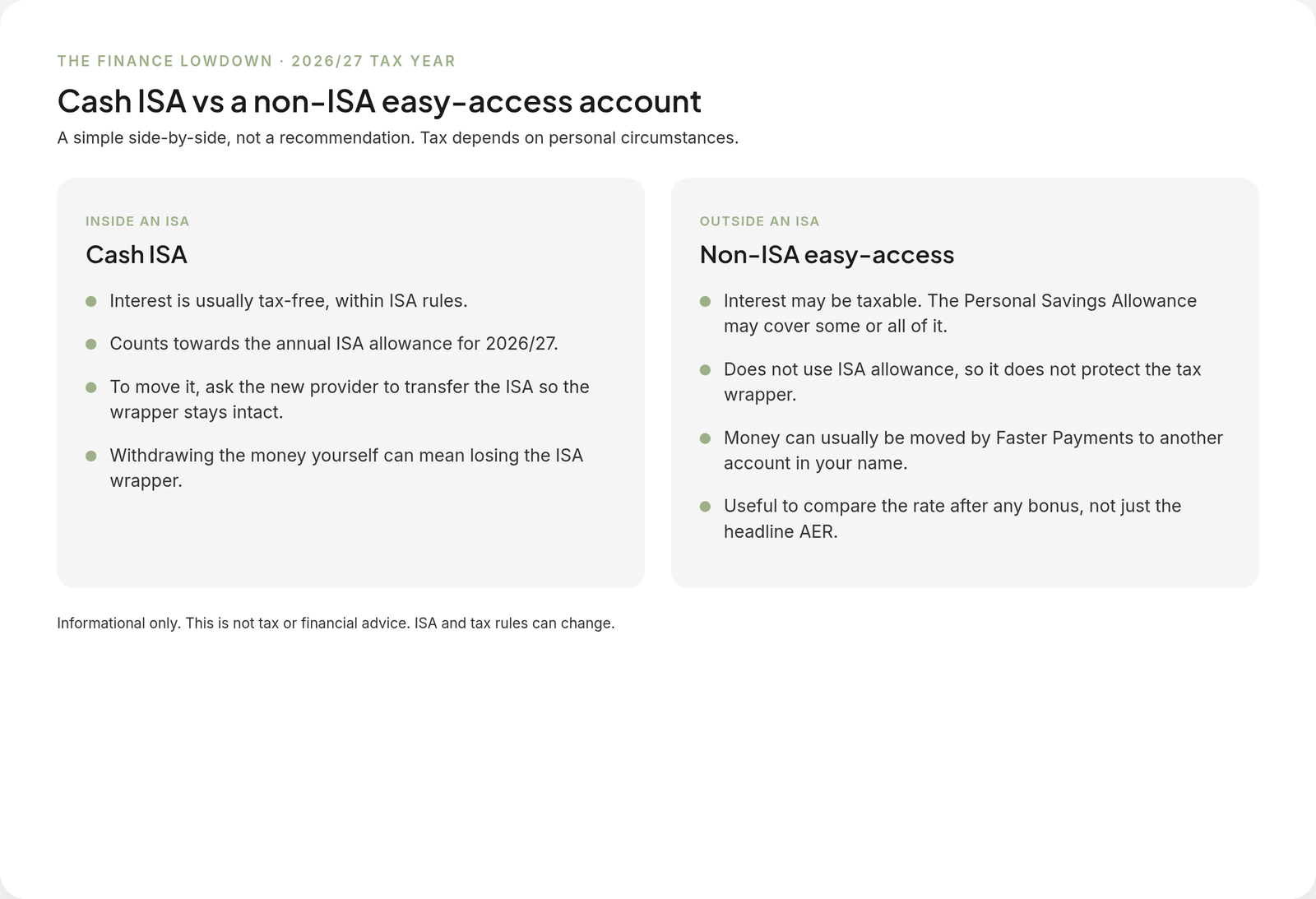
Table B: easy-access Cash ISAs
| Provider / account | Headline AER | Post-bonus AER | Transfers / flexibility | Notes | Visit |
|---|---|---|---|---|---|
| Plum Flexible Cash ISA | 4.73% AER (new money, incl. 2.19% 12-month bonus) | 2.54% AER after 12-month bonus | Bonus needs the money kept for 12 consecutive months and other conditions met; transfers in earn 3.75% AER incl. a 1.21% bonus. The earlier 5.00% new-customer window is no longer shown | Plum’s own Cash ISA page, 18 Oct 2026 (rate from 16 Oct 2026) — variable, can change | official site |
| Tembo Cash ISA — Easy Access | 4.00% AER variable (incl. 1.00% 12-month bonus) | 3.00% AER variable after 12-month bonus | Transfers in allowed. Tembo also offers a separate HomeSaver Cash ISA (5.5% AER only if you complete a mortgage through Tembo within 3 years) | Tembo’s own Cash ISA page and key features document, 18 Oct 2026 | official site |
| Sidekick Cash ISA | 3.23% AER | 3.23% AER (variable, no rate bonus) | All deposits earn 3.23% AER variable; ISA transfers of £10,000+ also get a £100–£500 cash bonus paid after 12 months. The earlier 4.61% headline is no longer shown | Sidekick’s own Cash ISA page, 15 Oct 2026 — flexible ISA | official site |
Moneybox Cash ISA (4.72% AER variable, including a 1.27% bonus for the first 12 months; underlying rate 3.45% AER — Moneybox new-customer rate as of 16 October 2026, checked 18 October 2026) is limited-access: a fourth withdrawal in a 12-month period, or a balance under £500, drops the rate to 0.75% AER (variable). Open from £500; UK residents aged 18+. It is not easy-access and is not in Table B. Chip and other bonus-heavy ISAs should be checked live for withdrawal caps.
Our picks by need
What easy-access actually means
“Easy-access” is a market label, not a legal status. In practice it usually means you can make withdrawals without serving a notice period and without being locked in for a set term.
It is not the same as:
- Notice accounts. You have to give notice (often 30, 60 or 90 days) before you can take money out, or you may lose interest. As of late August 2026, the top notice rates (around 4.38%) were not beating the no-notice headlines. Extra friction was not buying a higher advertised rate. See notice savings accounts.
- Fixed-term / fixed-rate bonds. You lock the money away for a set period, usually at a rate that does not change during that term. Early access is often blocked or penalised. See fixed-rate savings.
- Limited-access accounts. These can look similar until you make extra withdrawals. Some cut the rate if you take money out more than a set number of times. Moneybox’s Cash ISA, advertised at 4.72% AER variable including a 12-month bonus (Moneybox, rate as of 16 October 2026), is this type: a fourth withdrawal drops the rate to 0.75%. That is not easy-access, even if the money is not in a fixed term.
If extra withdrawals cut the rate, the account does not belong in an easy-access comparison.
How it works
You open the account with a bank, building society or other deposit-taker, pay money in, and interest is usually calculated daily and paid monthly or annually. The rate is almost always variable. The provider can change it.
Bank Rate does not automatically move your savings rate. The Bank of England held Bank Rate at 3.75% in September 2026, with the next MPC decision due on 5 November 2026 (source: Bank of England). Providers set their own rates.
Many already pay well below Bank Rate, especially on older “back-book” accounts. The average easy-access rate on a £10,000 balance was about 2.49% at the start of May 2026. That is closer to what many existing customers were earning than a new-customer headline.
UK CPI inflation was 3.1% in the year to August 2026 (source: ONS). Whether a savings rate keeps up with prices depends on the rate you actually earn after any bonus ends, and on tax if the account is not an ISA. That is a fact to weigh, not a forecast.
Interest on a non-ISA savings account can use up your Personal Savings Allowance (PSA): £1,000 of interest a year for a basic-rate taxpayer, £500 for a higher-rate taxpayer, and £0 for an additional-rate taxpayer. A Cash ISA sits inside your ISA allowance instead.
FSCS after £120,000
From 1 December 2025, the Financial Services Compensation Scheme (FSCS) protects up to £120,000 per person per authorised firm for eligible UK deposits.
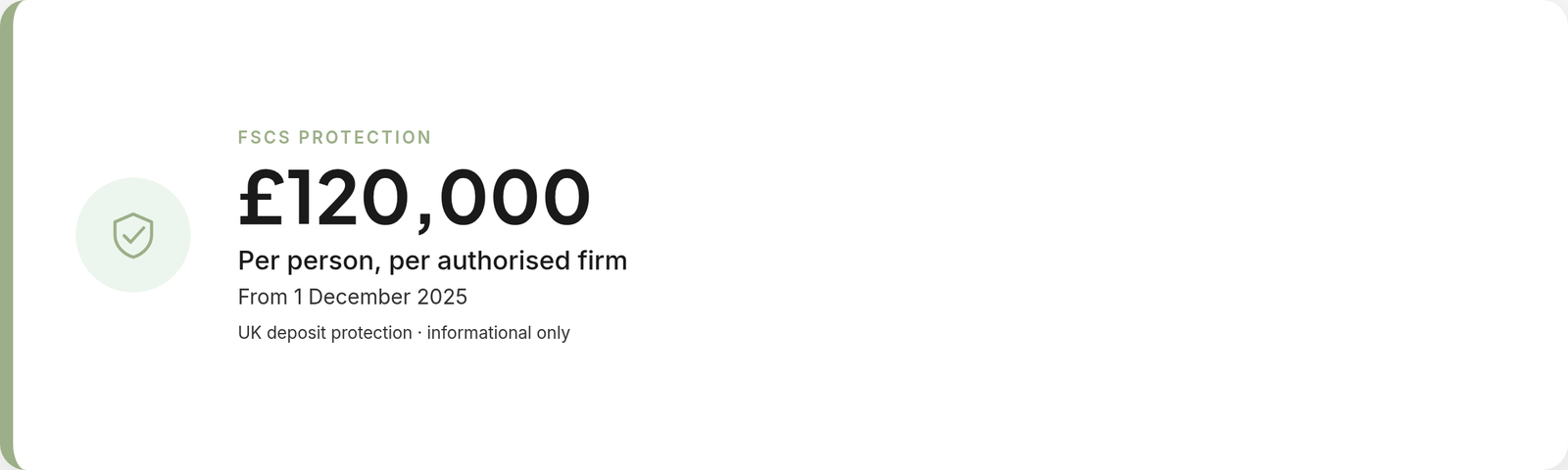
The limit is per authorised firm, not per brand. If two high-street names share a banking licence, balances across both count as one £120,000 pot.
Tesco Internet Saver is an example: FSCS is via Barclays, so the limit is shared with other Barclays brands. See FSCS protection.
- E-money balances (many e-money wallets and some app “pots”) are not FSCS-protected deposits.
- NS&I is backed by HM Treasury, not by FSCS.
- Temporary High Balances can be protected up to £1.4 million for six months, in defined life-event cases (for example certain property or inheritance payments). That is a separate, time-limited rule, not a higher everyday limit.
How to move savings
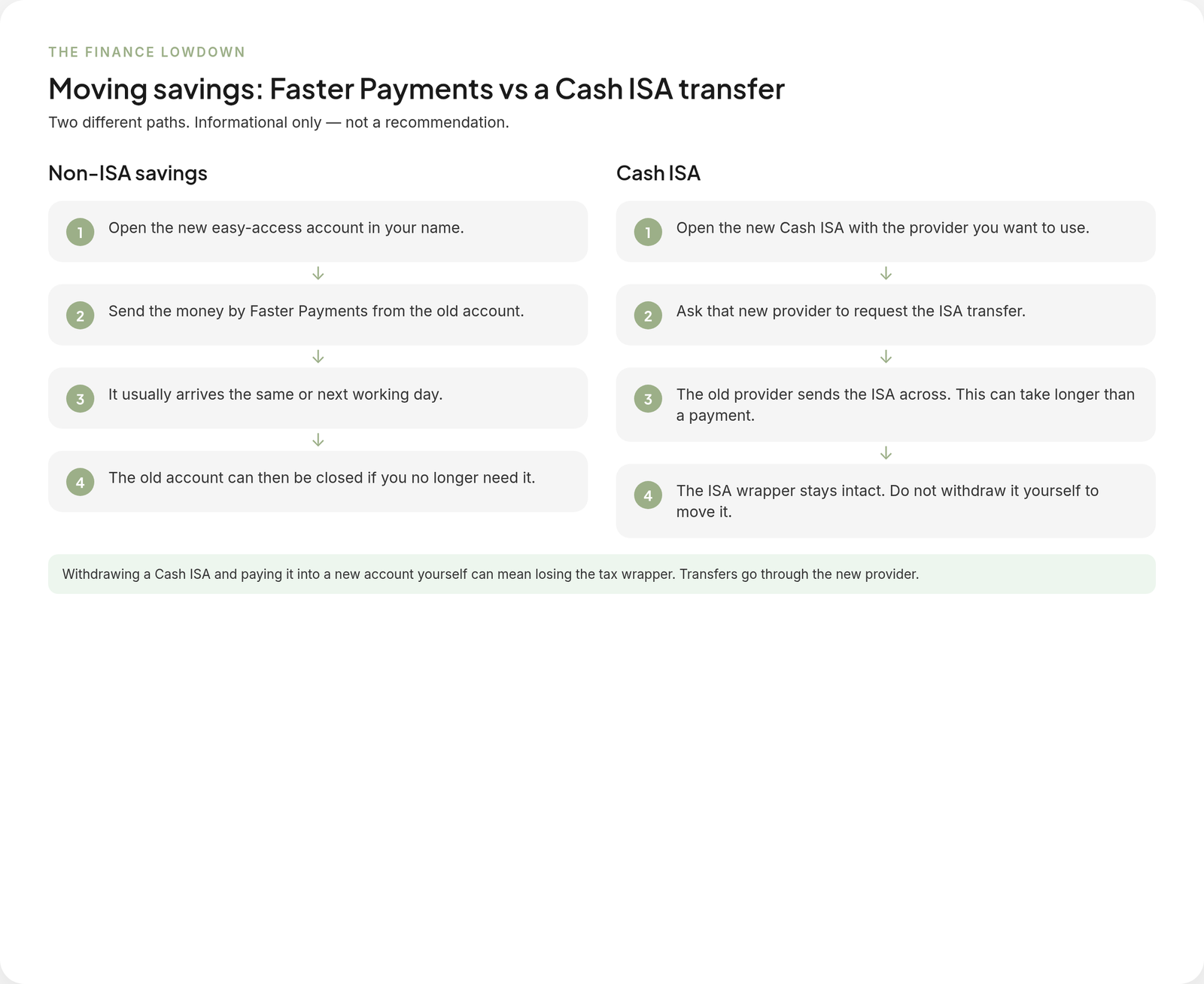
Current-account switches do not move savings. The Current Account Switch Service (CASS) moves a current account, its payments and its balance. It does not transfer savings accounts, Cash ISAs or linked savers.
Never withdraw cash yourself when transferring an ISA — always use your new provider’s official ISA transfer service to preserve your tax-free status.
A new savings account has to be opened, and the money moved, separately. See switching a savings account.
Moving a non-ISA easy-access account is usually a withdrawal to a current account and a payment into the new saver. Bonus terms and whether the new account is actually open and paying the expected rate are the details that matter.
Moving a Cash ISA is done as an ISA transfer. The receiving provider manages it. Cash-to-cash ISA transfers should complete within 15 working days.
Withdrawing and reopening is not an ISA transfer. Taking the money out can use up this year’s allowance and can put the interest back into taxable savings. Transfers can also pay a different rate from new subscriptions.
Sidekick is an example: transfers in pay 3.23% from day one.
How to transfer a Cash ISA
- Start an ISA transfer with the receiving provider. They manage it.
- Do not withdraw and reopen. That is not an ISA transfer and can use this year’s allowance.
- Allow up to 15 working days for a cash-to-cash transfer.
- Check the rate that applies to transfers. It can differ from the new-subscription headline.
Bonus cliffs
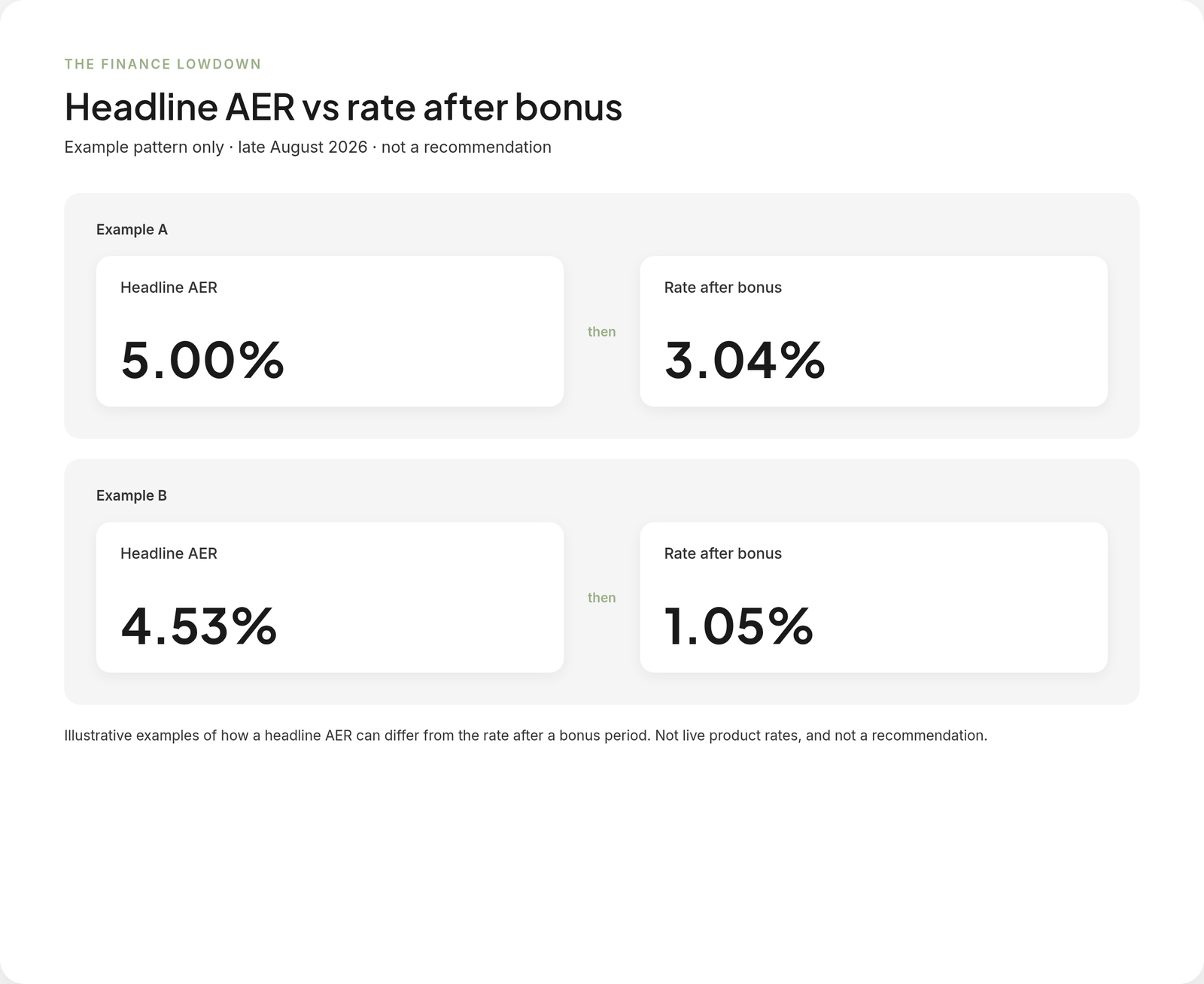
A bonus is a temporary extra rate. When it ends, the ongoing rate applies unless the money is moved. Where a bonus rate is shown, the post-bonus rate sits in the same section at equal weight.
The cliffs in this snapshot are not small:
- LemFi Instant Access: 5.00% to 3.04% after about six months
- Tesco Internet Saver: 4.24% (including a 3.19% fixed 12-month bonus) to 1.05% after 12 months (Tesco Bank, 19 Oct 2026)
- Cahoot Simple Saver Issue 20: 4.52% to about 1% after 12 months
- Chase Saver: 4.50% to 2.25%
- Plum Cash ISA: 4.73% (including a 2.19% 12-month bonus) then 2.54% (Plum, 18 Oct 2026)
- Tembo Cash ISA — Easy Access: 4.00% (including a 1.00% 12-month bonus) then 3.00% (Tembo, 18 Oct 2026)
- Sidekick Cash ISA: now 3.23% AER variable on all deposits (the earlier 4.61% headline is no longer shown); ISA transfers of £10,000+ get a £100–£500 cash bonus after 12 months instead (Sidekick, 15 Oct 2026)
Providers are not required to keep the launch rate. Bank Rate changing is not a reliable signal that yours will.
Important things to know
- Easy-access is a product description, not a statutory guarantee of unlimited free withdrawals. The withdrawal rules sit in the provider’s terms.
- Advertised AER is variable unless the product says otherwise. It can fall, including when Bank Rate does not.
- Headline and post-bonus rates both matter. A 12-month bonus that then pays around 1% is a very different deal from the launch number.
- Some rate tables mix £3,000 caps, mortgage kickers, current-account boosters, limited-access ISAs and true easy-access. They are not the same product.
- FSCS is £120,000 per person per authorised firm. Brands under one licence share that limit.
- The 2026/27 ISA allowance is £20,000. The under-65 Cash ISA cap is a 2027/28 rule.
- Rate sources: Moneyfacts (Fri 28 August 2026) and Which? (Mon 24 August 2026).
Frequently asked questions
What is an easy-access savings account?
An easy-access account is a savings product that, in practice, lets you withdraw without a notice period or a fixed term. It is a market label, not a statutory category. Some accounts look similar but cut the rate after extra withdrawals. Those are limited-access, not easy-access.
Does Bank Rate automatically change my savings rate?
No. Bank Rate was held at 3.75% in September 2026, with the next MPC decision due on 5 November 2026. Providers set their own variable rates. Many back-book easy-access accounts already pay well below Bank Rate.
What happens when a bonus rate ends?
The advertised launch rate stops and the ongoing rate applies. In this snapshot that drop can be large: for example Tesco Internet Saver from 4.24% (including a 3.19% fixed 12-month bonus) to 1.05% after 12 months (Tesco Bank, 19 Oct 2026), and LemFi Instant Access from 5.00% to 3.04% after about 183 days. Both figures belong in the same comparison.
Are easy-access savings protected?
Eligible UK deposits are covered by FSCS up to £120,000 per person per authorised firm (from 1 December 2025). Brands that share a licence share that limit. E-money is not FSCS. NS&I is Treasury-backed, not FSCS. Temporary High Balances can be covered up to £1.4 million for six months in defined life-event cases.
Does the Current Account Switch Service move savings?
No. CASS switches a current account. It does not move savings accounts or Cash ISAs.
How do you transfer a Cash ISA?
As an ISA transfer, handled by the receiving provider. Cash-to-cash transfers should complete within 15 working days. Withdrawing and reopening is not a transfer and can use up this year’s ISA allowance. Some providers pay a lower rate on transfers than on new subscriptions.
Is a Cash ISA the same as a non-ISA easy-access account?
No. A Cash ISA uses the 2026/27 ISA allowance of £20,000 and interest is tax-free. A non-ISA account can use the Personal Savings Allowance (£1,000 / £500 / £0). The under-65 Cash ISA cap of £12,000 starts from 6 April 2027 and does not apply to this tax year.
Do notice accounts currently pay more than easy-access?
On the figures in this guide, no. Top notice rates were around 4.38% in late August 2026, below the no-notice headlines.
Is an instant-access savings account the same as easy-access?
Yes, in practice. “Instant-access” and “easy-access” are both used for accounts that let you withdraw without a notice period or fixed term. Check the withdrawal rules, though: some limit how many withdrawals you can make before the rate drops. If you’d like the interest tax-free, see easy-access ISAs compared.