UK banking · August 2026
FSCS in 2026: £120,000 for deposits, £85,000 for investments
FSCS protects eligible deposits up to £120,000 per person, per authorised institution.
Last updated: 27 September 2026.
Key points
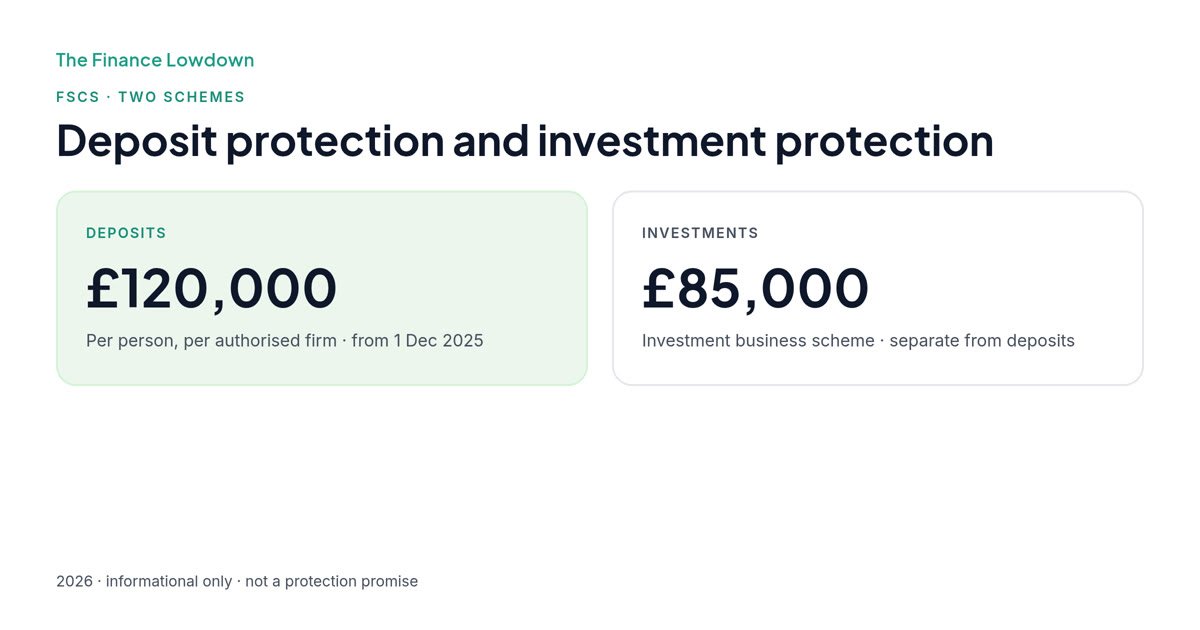
The Financial Services Compensation Scheme is a last resort if an authorised firm fails. From 1 December 2025, eligible UK deposits are covered up to £120,000 per person per authorised firm. Eligible investments stay at £85,000.
Those are two different schemes. This page is information, not a promise that any balance is safe.
There are no live The Finance Lowdown referral programmes on this page. The only checker link is the FSCS’s own site.
What FSCS is
The Financial Services Compensation Scheme (FSCS) is a last-resort scheme. If a UK-authorised firm fails, FSCS can pay eligible customers up to a stated limit.
It is not an insurance policy you buy. It is not a guarantee that every product with an FSCS logo is covered in the same way.
Two schemes sit under that badge, with two different limits. Mixing them up is why some older guides still quote £85,000 for deposits.
Limits
Two schemes: deposits vs investments
The FSCS limit 2026 picture is two schemes, not one number.
Deposits. From 1 December 2025, eligible UK deposits are covered up to £120,000 per person per authorised firm. That includes current-account credit balances and Cash ISAs, which are deposits.
The old £85,000 figure is historical. Deposit payouts are typically aimed at around seven working days.
Investments. Eligible investment business is still covered up to £85,000 per person per authorised firm. That limit did not rise when the deposit limit did.
It is for a firm failure or a shortfall in assets, including some advice and shortfall claims. It is not compensation for the market going down. It is not compensation for the issuer of a share or bond going bust.
Investment claims take months, not days.
| Feature | Deposits | Investments |
|---|---|---|
| Live limit | £120,000 from 1 December 2025 | £85,000 (unchanged) |
| Limit applies | Per person, per authorised firm | Per person, per authorised firm |
| Typical products on this page | Current-account credit balances and Cash ISAs | Eligible investment business, including investments inside a Stocks and Shares ISA |
| Typical payout | Aimed at around seven working days | Months, not days |
| Does not cover | A savings rate falling | Market falls, or the issuer of a share or bond going bust |
A Cash ISA sits in the deposit scheme. Investments inside a Stocks and Shares ISA sit in the investment scheme. See easy-access savings accounts in the UK and Stocks and Shares ISA fees.
Authorised firms
Joint and sole accounts
Joint accounts
On a joint account with two named holders, each person typically has their own £120,000 deposit limit on that joint balance. That is why a joint account is often described as covered up to £240,000. It is two people, each with one limit, on that account.
A sole account and a joint account at the same authorised firm do not stack into two full personal pots. The £120,000 is per person per firm.
Money in your name at that firm, including your share of a joint account, counts toward one personal £120,000. They do not double up.
This is not a how-to for spreading cash across brands.
Temporary high balances
In defined life-event cases, FSCS can cover a temporary high balance above the usual deposit limit: up to £1.4 million for six months (it was £1 million). Injury and incapacity payments can be unlimited under that rule.
Cover is not pre-confirmed. You evidence the life event after a firm fails. FSCS aims to deal with these claims in about three months.
Typical events include selling a main home, and inheritance. This is a separate, time-limited rule, not a higher everyday limit.
Exclusions
What is not covered
FSCS does not cover:
- Market falls (your shares or funds dropping in value)
- An e-money firm (EMI) failing. E-money is not an FSCS-protected deposit. The FSCS badge is a deposits badge, not an e-money badge. Some older guides still quote £85,000 for deposits, which is out of date.
- Crypto.
- Unauthorised firms.
- APP-fraud reimbursement. The £85,000 APP figure is a Payment Systems Regulator reimbursement limit, not the deposit guarantee scheme.
NS&I is backed by HM Treasury, not by FSCS.
The FSCS protection checker is a deposits checker. It does not, by itself, tell you that an investment, an e-money wallet, or a crypto product is covered.
Exceptions
Uninvested cash on a platform or in a Stocks and Shares ISA
This article does not print one FSCS figure for uninvested platform cash. Whether that cash is an eligible deposit, or client money under the FCA Client Assets Sourcebook, depends on how the platform holds it.
Those are different regimes. Check the platform’s own wording.
Two different things called CASS
Current Account Switch Service (CASS) is run by Pay.UK. It moves an eligible current account.
It does not move savings or ISAs, and it does not create a new FSCS pot when brands share a licence. See current account switch bonuses.
Client Assets Sourcebook (CASS) is an FCA rulebook on how firms hold client money and custody assets. It is not the switch service. Uninvested platform cash may sit under this CASS, or as a deposit, depending on the firm.
The acronym is the same. The schemes are not.
The catch
Important things to know
- Live deposit limit: £120,000 per person per authorised firm from 1 December 2025.
- Investment limit: still £85,000. It did not rise. It does not cover market falls or issuer bust.
- The limit is per authorised firm, not per brand.
- Joint: two named holders typically two limits on that joint account. Sole plus joint at the same firm share one personal £120,000.
- Temporary high balances: up to £1.4 million for six months in defined life-event cases; not pre-confirmed.
- NS&I is Treasury-backed, not FSCS.
- Current Account Switch Service ≠ FCA Client Assets Sourcebook.
- APP-fraud £85,000 is PSR, not the deposit scheme.
Practical implications
How to check a firm
- Look up the brand on the FCA Register and note the firm name and FRN (firm reference number).
- Check whether other brands share that authorised firm.
- Use the FSCS protection checker: https://www.fscs.org.uk. It is a deposits checker.
Re-check FRNs on the PRA list and the FCA Register. The licence snapshot above is dated. Do not assume extra shared groups.
Deposit payouts are typically aimed at around seven working days after a deposit-taker fails. Investment claims take longer, often months.
FSCS protection limits: FAQs
What is the FSCS limit in 2026?
There are two FSCS limits in 2026. From 1 December 2025, eligible UK deposits are covered up to £120,000 per person per authorised firm. Eligible investments stay at £85,000. Those are two different schemes. The old £85,000 deposit figure is historical, not the live deposit limit.
What does FSCS £120,000 cover?
See Two schemes: deposits vs investments above.
What does FSCS £85,000 cover?
Eligible investment business is still covered up to £85,000 per person per authorised firm. That limit did not rise when the deposit limit did. It is for a firm failure or a shortfall in assets. It is not compensation for the market going down, and it is not the live deposit limit.
How do I use the FSCS checker?
Look up the brand on the FCA Register and note the firm name and FRN. Then check whether other brands share that authorised firm. The FSCS protection checker is at https://www.fscs.org.uk. It is a deposits checker. It does not, by itself, tell you that an investment or an e-money wallet is covered.
How much FSCS cover does a joint account have?
See Joint accounts above.
What is an FSCS temporary high balance?
See Temporary high balances above.
Do first direct and HSBC share an FSCS limit?
See Per authorised firm, not per brand above.
Is a Cash ISA covered the same way as a Stocks and Shares ISA?
See Two schemes: deposits vs investments above.
Is NS&I covered by FSCS?
No. NS&I is backed by HM Treasury, not by FSCS. The FSCS protection checker is a deposits checker for authorised firms. Treasury backing is a different arrangement from the deposit guarantee scheme.
Is e-money covered by FSCS?
No. FSCS does not cover an e-money firm (EMI) failing. E-money is not an FSCS-protected deposit. The FSCS badge is a deposits badge, not an e-money badge. Crypto and unauthorised firms are also not covered.
Get our weekly email
The Friday Finance Lowdown — five minutes of the money stuff worth knowing.
Free to join. See our privacy policy for how we handle your email address.