UK banking · September 2026
Pay by Bank explained: how open-banking payments differ from cards
Last updated: 27 September 2026.
Key points
Key decision routes
You still need a current account that supports open-banking payments: UK current accounts 2026. Banking hub: banking.
Open banking for reading account data (budgeting apps) is related tech but not the same as paying: UK budgeting apps. Broader scam patterns: money scams 2026.
Plain-English glossary (once)
- Open banking — rules and tech so regulated firms can, with your consent, start payments or read account data via bank connections (APIs).
- PISP (Payment Initiation Service Provider) — an FCA-authorised firm allowed to start a payment for you.
- AIS / AISP — a firm that reads account data (e.g. budgeting apps) — related, not the same as paying.
- Faster Payments — the UK’s near-instant bank-to-bank payment system.
- SCA (Strong Customer Authentication) — extra proof it is you — e.g. biometrics or passcode in the bank app.
- VRP (Variable Recurring Payments) — ongoing payment mandates (sweeping between your own accounts came earlier; wider retail use is still evolving).
How it works behind the scenes
A PISP connects the merchant to your bank using open banking, with your consent. Authentication stays with your bank.
The PISP should not see your bank login password. Check authorised firms on the FCA Register.
How a checkout usually feels
- Select Pay by Bank (wording varies: “Pay by bank transfer”, “Pay from your bank”).
- Pick your bank from a list.
- Redirect or deep-link into your bank’s app or site.
- Check amount and payee → approve with SCA.
- Return to the shop with confirmation.
You authorise a specific payment (amount and payee). That is different from handing over a card that can be charged again later — unless you set up a separate recurring mandate or VRP.
Pay by Bank vs card (consumer view)
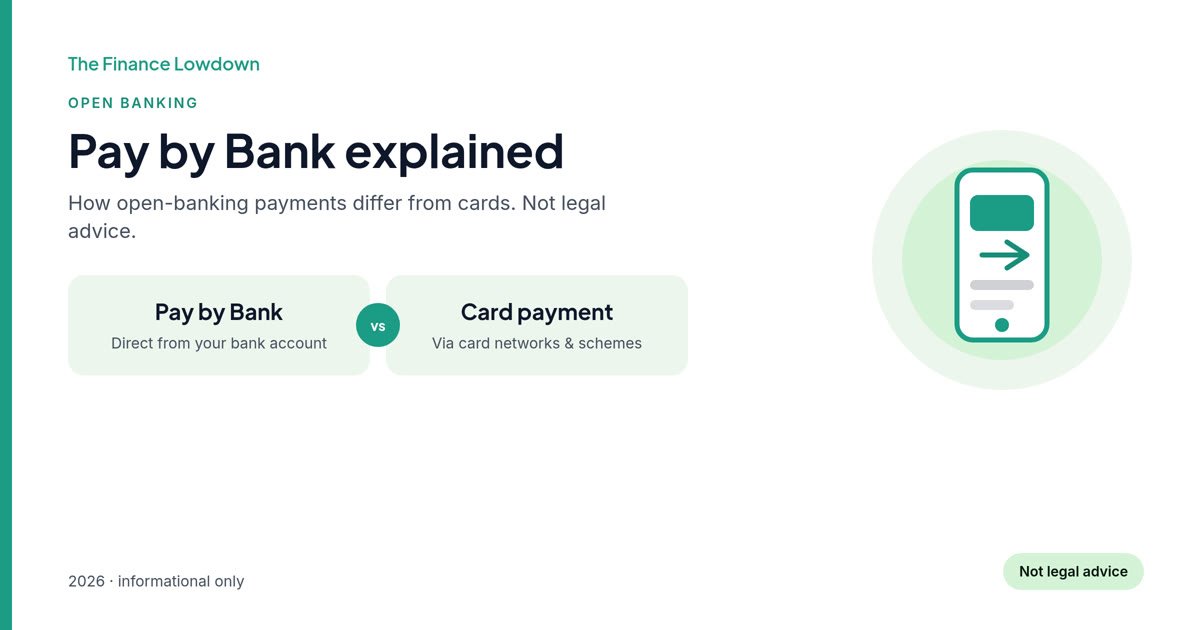
Pay by Bank lets you pay directly from your current account. You approve in your own banking app. Money usually moves on Faster Payments.
You do not type card numbers. A regulated PISP (Payment Initiation Service Provider) connects merchant and bank with your consent; authentication stays with your bank.
| Pay by Bank | Debit / credit card | |
|---|---|---|
| How you authorise | Choose bank → approve in banking app (Face ID / fingerprint / passcode — SCA) | Card number / digital wallet |
| Where money comes from | Current account (bank transfer) | Card scheme rails |
| Typical consumer fee | Usually £0 (like a normal Faster Payment) | Usually £0 for UK purchases; FX fees abroad possible |
| Merchant cost | Often lower than card interchange (why shops offer it) | Card fees to the merchant |
| Speed | Often seconds once approved | Instant for the shopper; merchant settlement differs |
| Chargeback (card scheme) | Not a card — no Visa / Mastercard chargeback in the usual sense | Debit chargeback may apply for some disputes |
| Section 75 (credit card, CCA 1974) | Does not apply (not a credit-card purchase) | May apply to credit-card buys between £100 and £30,000 |
| Scam / APP path | May be treated as a bank transfer → PSR APP rules if you are tricked into paying a fraudster | Different: chargeback / Section 75 / unauthorised card rules |
Consent is for a specific payment (amount / payee) — different from handing over a card that can be charged again later, unless you set up a separate recurring mandate / VRP. You still need a supporting current account: UK current accounts 2026.
Shoppers normally pay no extra fee. Shops often add Pay by Bank because processing costs can be lower than cards — that is not a reason this site pushes one method over another.
Three protection buckets
Protections are different from cards — not “none”. Which path applies depends on the facts.
Protections are different from cards — not “none”. Never flatten this to “Pay by Bank = no protection”.
Which path applies depends on the facts. Not legal advice.
| Bucket | When it applies | What to know |
|---|---|---|
| 1) Merchant dispute (genuine shop — goods wrong / not delivered) |
You paid a real retailer; problem with the order | Start with the retailer’s refund policy. Card chargeback and credit-card Section 75 usually do not attach the same way (not a card payment). Marketplace guarantees (e.g. Amazon A-to-Z) may still cover that retailer’s Pay by Bank orders — protections differ from cards and are still evolving. Regulated firm complaints → possibly Financial Ombudsman Service. APP reimbursement does not cover every failed delivery from a real shop. |
| 2) APP / bank-transfer scam (tricked into paying a fraudster) |
You approved a payment to a scammer (e.g. fake shop / phishing payee) via Faster Payments or CHAPS on or after 7 October 2024 | PSR mandatory APP reimbursement may apply (FCA / PSR): typically up to £85,000; usually within 5 working days (complex cases longer); firms may apply up to a £100 excess except for vulnerable customers; “gross negligence” exceptions exist. Contact the sending bank immediately; report to police / Action Fraud (or Police Scotland). This £85,000 APP cap is NOT FSCS deposit protection (£120,000 from 1 Dec 2025 if a bank fails). Never mix the two. |
| 3) Unauthorised payment (you did not approve it) |
Payment went out without your approval | Separate rules under the Payment Services Regulations — tell the bank ASAP. FCA guidance: refund often by the end of the next business day unless exceptions apply. Time limit to claim often 13 months (FCA consumer pages). Unauthorised ≠ APP ≠ merchant dispute. |
1) Genuine shop — goods wrong or not delivered
- Start with the retailer’s refund policy.
- Card chargeback and credit-card Section 75 usually do not attach the same way, because Pay by Bank is not a card payment.
- Marketplace guarantees (for example Amazon A-to-z) may still cover that retailer’s Pay by Bank orders — Open Banking has noted Amazon coverage — but protections differ from cards and are still evolving.
- Unhappy with a regulated firm’s handling → the firm’s complaints process → possibly the Financial Ombudsman Service.
2) You were tricked into paying a fraudster (APP / bank-transfer scam)
Authorised Push Payment (APP) fraud is when you approve a payment to a scammer.
- If the payment went via Faster Payments or CHAPS to a scam account on or after 7 October 2024, PSR mandatory APP reimbursement may apply (FCA / PSR): typically up to £85,000, usually within 5 working days (complex cases longer). Firms may apply up to a £100 excess except for vulnerable customers. “Gross negligence” exceptions exist.
- Contact the sending bank immediately. Report to the police / Action Fraud (or Police Scotland).
- Pay by Bank to a fake shop or phishing payee can fall in this bucket — not the same as a normal Amazon order dispute.
Careful: this £85,000 APP reimbursement cap is not the same as FSCS deposit protection (£120,000 from 1 December 2025 if a bank fails). Never mix the two figures. Deposit protection if a bank fails is separate — FSCS £120,000 from 1 December 2025 (see FSCS pages when consulting that topic).
3) Unauthorised payment (you did not approve it)
- Separate rules under the Payment Services Regulations — tell the bank ASAP. FCA guidance: refund often by the end of the next business day unless exceptions apply.
- Time limit to claim is often 13 months (FCA consumer pages).
Never flatten this to “Pay by Bank = no protection”. Say different protection, depending on the scenario.
Scam and phishing angles
Informational checklist only. These rows do not score payment methods or PISPs.
| Trap | What it means |
|---|---|
| Fake “Pay by Bank” buttons | Phishing sites that look like checkout → you approve a transfer to criminals |
| Spoofed bank login pages | Prefer the official bank app; check URLs. Authentication should stay with your bank |
| Impersonation invoices | “Bank / HMRC / courier — pay this invoice via open banking.” Verify on an official channel |
| Wrong PISP / merchant | Check the PISP / merchant is who you think; use the FCA Register for authorised firms |
| Cold-call pressure | Take Five — never move money because someone cold-called |
| Assuming card-style chargeback / Section 75 | Pay by Bank is not a card payment — those paths usually do not apply the same way |
| Mixing APP cover with a real-shop dispute | APP is for payments to a fraudster. Failed delivery from a genuine retailer is usually a merchant / marketplace path |
| Mixing APP £85k with FSCS £120k | Different schemes, different triggers — firm failure vs scam transfer |
Five checks before you approve (process only)
- Am I in my real bank app (not a random website)?
- Is the amount what I expect?
- Does the payee name match the shop I think I’m paying?
- Did I start this checkout myself — or did a cold call / message push me here?
- For an unexpected bill, can I verify the request on an official channel?
Cited / seen: Amazon UK Pay by Bank (2026, TrueLayer per Open Banking); eBay cited in Open Banking insights; HMRC “Pay by bank account” since 2021; utilities / bills; some apps and QR flows. Still optional at many checkouts.
Rules are still developing — policy outcomes are not yet known. Broader scam patterns: money scams 2026.
- Fake “Pay by Bank” buttons on phishing sites → you approve a transfer to criminals.
- Spoofed bank login pages — prefer the official app; check URLs.
- Impersonation: “bank / HMRC / courier — pay this invoice via open banking”.
- Check the PISP / merchant is who you think; use the FCA Register for authorised firms.
- Take Five: never move money because someone cold-called.
More on wider scam patterns: money scams 2026.
Five checks before you approve
- Am I in my real bank app (not a random website)?
- Is the amount what I expect?
- Does the payee name match the shop I think I’m paying?
- Did I start this checkout myself — or did a cold call / message push me here?
- For an unexpected bill, can I verify the request on an official channel?
Where you may see it
Cited / seen: large online retail (Amazon UK added Pay by Bank at checkout in 2026, TrueLayer partnership per Open Banking), marketplaces (eBay cited in Open Banking insights), government (HMRC “Pay by bank account” for taxes since 2021), utilities and bills, some apps and in-store QR flows. It is still optional at many checkouts beside cards and wallets.
Open Banking Ltd has published adoption stats (for example 15m+ users and high November 2025 volumes on openbanking.org.uk) — date-stamp any figure you quote from there.
Policy watch (calm)
HM Treasury and the FCA continue work on the long-term open banking / open finance framework, VRP expansion and possible commercial access charging. Rules are still developing — outcomes are not yet known.
Pay by Bank: FAQs
What is Pay by Bank?
Pay by Bank lets you pay a shop or bill directly from your current account. You approve the payment in your own banking app. Money usually moves on Faster Payments. You do not type card numbers. This page is not advice to use or avoid a payment method.
How does Pay by Bank differ from a debit or credit card?
Pay by Bank is an account-to-account transfer started via open banking. Cards run on card-scheme rails. Chargebacks and Section 75 do not attach the same way, because Pay by Bank is not a card payment. Protections differ by scenario.
Do shoppers usually pay a fee for Pay by Bank?
Usually £0 for the shopper — like a normal Faster Payment. Shops often offer it because merchant processing costs can be lower than cards. That is not a reason this site pushes one method over another.
Does Section 75 apply to Pay by Bank?
No. Section 75 of the Consumer Credit Act 1974 applies to certain credit-card purchases. Pay by Bank is not a credit-card purchase, so Section 75 does not apply in the usual way.
Can I use a card chargeback on a Pay by Bank payment?
Not in the usual Visa / Mastercard chargeback sense, because Pay by Bank is not a card payment. Start with the retailer’s refund policy. Marketplace guarantees may still cover some retailer Pay by Bank orders — protections differ from cards.
What if I was tricked into paying a fraudster?
That may fall under Authorised Push Payment (APP) rules if you approved a bank transfer to a scammer. PSR mandatory APP reimbursement may apply — typically up to £85,000. That £85,000 is not the same as FSCS £120,000 deposit protection.
Is APP £85,000 the same as FSCS £120,000?
No. APP reimbursement is about bank-transfer scams under PSR rules (typically up to £85,000). FSCS protects eligible deposits if a firm fails (£120,000 from 1 December 2025). Never mix the two.
What if I did not authorise the payment?
Unauthorised payments sit under separate Payment Services Regulations rules. Tell the bank ASAP. FCA guidance: refund often by the end of the next business day unless exceptions apply. Time limit to claim is often 13 months.
How is Pay by Bank different from open banking in budgeting apps?
Budgeting apps often use account information services (AIS) to read balances and transactions. Pay by Bank uses payment initiation (PISP) to start a payment. Related tech, different job. See UK budgeting apps.
Does this page recommend Pay by Bank?
No. This is general information, not personal advice. It is not advice to choose a payment method and not legal advice. There are no apply or sign-up links.
Get our weekly email
The Friday Finance Lowdown — five minutes of the money stuff worth knowing.
Free to join. See our privacy policy for how we handle your email address.